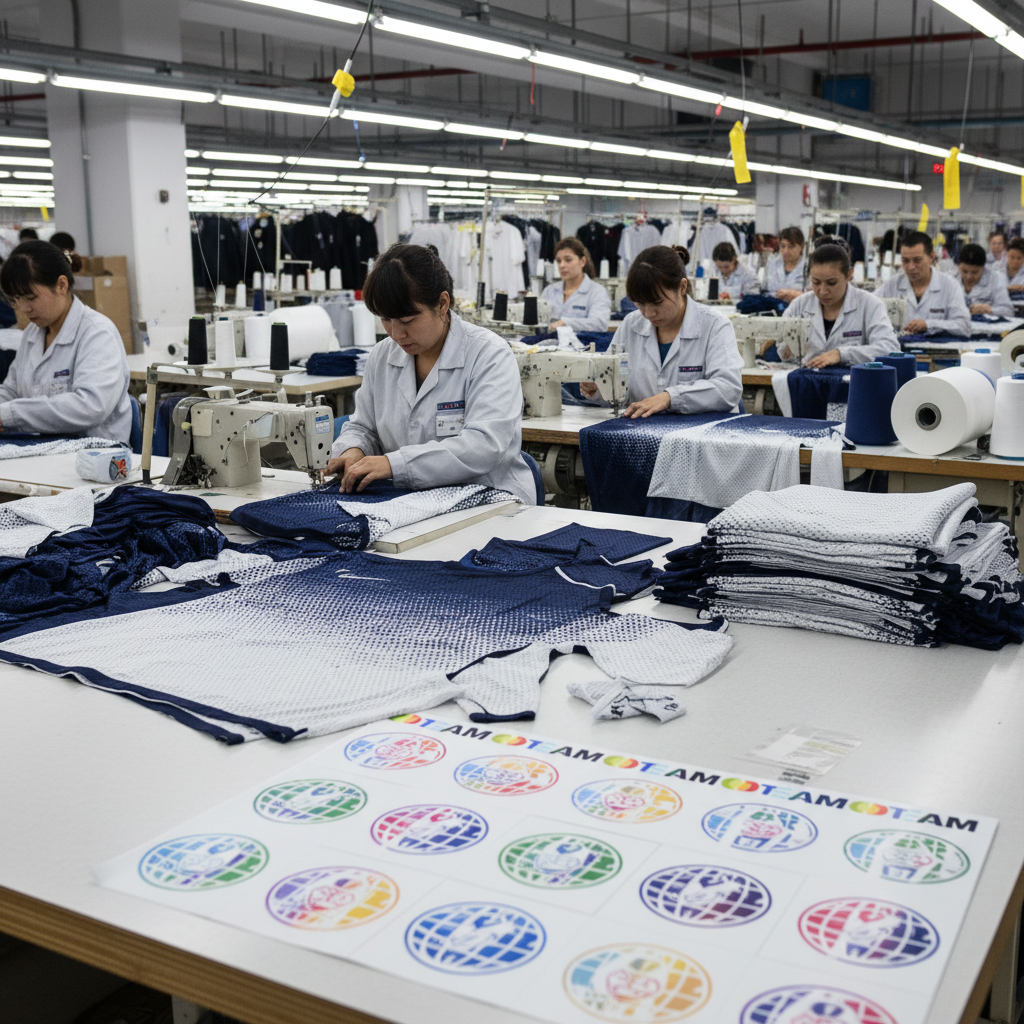
This article analyzes World Cup jersey production from a B2B sourcing angle, covering fabric specs, printing technologies, compliance, capacity, MOQ, quality control, and regional supply chain risks to support procurement decisions for global buyers.
Definition
What is a World Cup jersey? It is a performance-oriented football shirt engineered for elite competition, combining moisture management, breathability, durability, and brand or federation identity under strict tournament regulations.
Key Points for B2B Buyers
- World Cup jersey fabrics are typically 120–180 GSM recycled polyester with engineered mesh zones.
- Moisture management and breathability performance are quantifiable via lab testing, not visual inspection.
- Compliance with standards such as OEKO-TEX STANDARD 100, GRS, and BSCI is becoming a baseline requirement.
- Stable capacity, realistic MOQ, and confirmed lead times are critical in pre-tournament production peaks.
- Printing methods (sublimation, heat transfer, screen print) drive both cost structure and durability.
- Digital product data, size grading, and QA protocols significantly reduce claim rates and rework.
Technical Specifications of World Cup Jerseys
From a procurement perspective, a World Cup jersey is defined less by branding and more by its material and process specification. Across leading brands, we typically see lightweight, high-stability knitted structures designed to balance moisture management, mechanical strength, and printability. Elite match jerseys and replica jerseys often share base technologies but differ in weight, construction, and finishing, which has direct implications for pricing and capacity planning.
Fabric Type, GSM, and Structure
Most World Cup jerseys use 100% polyester or recycled polyester (rPET) warp or circular knits. Typical fabric parameters: 120–150 GSM for elite match jerseys and 150–180 GSM for replica or fan jerseys, with ±5% tolerance. Filament counts are often 75D–100D microfibers; cross-sections may be modified (e.g., trilobal or multi-channel) to enhance capillary wicking. Mesh panels around side seams, upper back, or underarms may drop to 110–130 GSM with larger knit apertures (open area 10–20%) to increase airflow.
Knitting structures are usually interlock, double knit, or engineered jacquard. For procurement, this means selecting suppliers capable of consistent gauge control (28–32 GG common for fine jerseys) and low fabric skew. Deviations greater than 3% in dimensional stability after washing can trigger size conformity issues, especially considering tight tournament timelines.
Moisture Management and Breathability
Moisture management is not a marketing concept; it is measurable. Standards such as AATCC 195 (liquid moisture management) and ASTM E96 (water vapor transmission) are widely used. For high-performance jerseys, we generally see wicking times below 3–4 seconds and vertical wicking heights above 10 cm in 30 minutes. Air permeability often ranges from 150 to 300 mm/s (ASTM D737) for main body fabric, while mesh inserts can exceed 400 mm/s. These metrics are critical in hot and humid host environments, especially in Asia Pacific and parts of Africa.
Finishing chemistries such as hydrophilic wicking finishes and anti-odor treatments must balance performance with compliance. According to textile chemistry reviews, fluorocarbon-free and bluesign-approved finishes are increasingly requested by European retailers to reduce restricted substances exposure, aligning with OEKO-TEX STANDARD 100 criteria documented by the association in its certification guidelines.
Dimensional Stability, Color Fastness, and Durability
Because jerseys are often personalized, buyers need predictable wash performance. Dimensional change within ±3% (ISO 5077) is a common threshold. Color fastness to washing (ISO 105-C06) typically targets grade 4 or higher for color change and staining. For perspiration (ISO 105-E04), grades of 4–5 are expected, particularly for dark or saturated team colors. Seam strength above 150–200 N (ISO 13935) and pilling resistance above grade 4 (ISO 12945-2) are typical technical targets for match and replica jerseys.
Materials, Sustainability, and Compliance
Global buyers are moving from conventional polyester to recycled content without compromising performance. For World Cup cycles, this shift needs to be backed by verifiable chain-of-custody documentation and robust social compliance frameworks in high-volume regions such as Southeast Asia and North Africa.
Recycled Polyester and GRS Certification
Recycled polyester content in replica jerseys has reached 50–100% in many major programs. The Global Recycled Standard (GRS) requires a minimum of 20% recycled input, but brands targeting sustainability messaging usually specify at least 50%. For procurement, GRS certification allows traceability from bottle flake or pre-consumer waste to yarn and fabric. According to Textile Exchange’s market reports, the share of recycled polyester in the global polyester market exceeded 14% in recent years, with steady growth in apparel applications.
Buyers should ensure that spinners and knitting mills can provide valid scope and transaction certificates. Failure to align paperwork with physical shipments can delay customs clearance in the EU and US, especially as due diligence regulations become stricter.
Chemical Safety and OEKO-TEX STANDARD 100
For jerseys worn in contact with skin under high sweat conditions, restricted chemicals are a key risk. OEKO-TEX STANDARD 100 certification at product class II or I level is frequently requested. The standard limits substances such as azo dyes releasing carcinogenic amines, formaldehyde, phthalates, heavy metals, and per- and polyfluoroalkyl substances (PFAS). The OEKO-TEX association regularly updates limit values in line with REACH and other regulations, as detailed in its public criteria documents.
Social Compliance: BSCI, WRAP, and Regional Risks
World Cup-related programs often face NGO and media scrutiny. Social audit frameworks such as BSCI and WRAP are now baseline requirements for many European and North American buyers. Factories in Bangladesh, Vietnam, China, Cambodia, and North Africa are expected to provide current audit reports, usually renewed every 12–24 months. Non-compliance risk is not theoretical; several media investigations in previous tournament cycles have highlighted wage and overtime issues in jersey supply chains, underscoring the need for verified documentation and corrective action tracking.
Key Manufacturing Processes for World Cup Jerseys
From yarn to finished garment, each process step influences cost, lead time, and quality risk. For large-scale jersey programs, production windows are narrow, generally 6–9 months before a World Cup, which constrains trial-and-error and raises the value of process control.
Knitting, Dyeing, and Finishing
Knitting lines must manage high-volume runs with color consistency across multiple lots, especially for federation colors that need exact Pantone alignment. Dyehouse capacity is often the bottleneck; average lead time for bulk dyeing and finishing can be 10–20 days after lab dip approval. Temperature and pH control during dyeing are central to color fastness. Finishing includes application of wicking agents, softeners, and sometimes antimicrobial treatments, followed by stentering to fix width and dimensional stability.
Printing and Badging: Sublimation vs Heat Transfer
World Cup jerseys usually combine several decoration techniques: sublimation for large color gradients or patterns, screen printing or digital print for sponsors, and heat transfer or silicone badges for crests. Sublimation offers excellent color fastness and does not affect fabric hand-feel, but it is primarily suitable for light-colored polyester fabrics. For dark base fabrics or metallic effects, heat transfer or screen print is more common. According to industry data, heat transfer logos can maintain appearance after 25–40 wash cycles if applied under the correct pressure and temperature profiles, while poorly controlled applications can show cracking much earlier.
Cutting, Sewing, and Bonding
Modern jerseys adopt ergonomic paneling and sometimes bonded seams. Automated spreading and marker planning can reduce fabric wastage by 2–4%, significant at volumes exceeding 100,000 pieces. Overlock, flatlock, and coverstitch machines are standard; some elite jerseys integrate taped or welded seams using thermoplastic films. Needle selection (e.g., ballpoint needles for knits) and stitch density (e.g., 3–4 stitches/cm) are key parameters to avoid seam slippage and popped stitches. Quality audits often set AQL levels of 1.5–2.5 for major defects in export-oriented factories.
Capacity, MOQ, and Lead Time Planning
World Cup jersey demand is highly time-bound. Misalignment between merchandising forecasts and production capacity directly converts to markdowns or stock-outs. Procurement teams therefore focus on capacity, minimum order quantities (MOQ), and realistic lead times when selecting suppliers.
Production Capacity and Line Efficiency
A dedicated jersey production line with 30–40 sewing operators typically outputs 600–1,000 pieces per shift, depending on design complexity and automation level. For orders above 200,000 pieces, multi-line planning or multi-site sourcing is common. In Asia Pacific hubs like Vietnam and Indonesia, larger factories may reach monthly jersey capacity above 300,000–500,000 units. However, pre-World Cup peaks overlap with regular league jersey programs, so effective capacity may be 20–30% lower than nominal if planning starts late.
MOQ and Style Complexity
For standard replica jerseys with common fabrics and trims, many suppliers offer MOQs in the range of 500–1,000 pieces per color per style. For fully custom federations or clubs with unique knit patterns, MOQs of 2,000–3,000 pieces per color are typical due to yarn-dyeing or jacquard knitting constraints. Personalization (player name and number) is usually handled via separate heat transfer stocks, allowing lower per-name MOQ but adding inventory complexity for number sets and letters.
Lead Times and Logistics to Key Regions
End-to-end lead time from final tech pack to ex-factory is often 75–120 days: 15–25 days for fabric development and lab dips, 20–30 days for bulk fabric production, and 20–40 days for cutting, sewing, printing, and packing. Shipping adds 7–35 days depending on mode and destination: Asia Pacific intra-region shipments may take 7–14 days by sea, while to Europe or North America typical sea transit is 25–35 days. Airfreight can compress this to 3–7 days but with significantly higher cost per kilogram, which is rarely feasible for large tournament volumes except for emergency replenishments.
Traditional vs Modern World Cup Jersey Production
Over the last two decades, jersey production has shifted from heavy, simple knits toward engineered, digitally managed performance systems. This transition affects everything from fabric spec to data flows between buyer and supplier.
| Feature | Traditional World Cup Jerseys | Modern World Cup Jerseys |
|---|---|---|
| Fabric weight and structure | 180–220 GSM, basic single jersey or piqué, minimal zoning | 120–180 GSM, engineered knit with mesh ventilation zones |
| Material composition | Virgin polyester, limited micro-denier usage | High micro-denier recycled polyester (50–100% rPET typical) |
| Moisture management | Basic wicking or none, limited lab verification | Optimized capillary structures with test-based performance targets |
| Decoration methods | Predominantly screen printing, sewn badges | Mix of sublimation, digital print, heat transfer, bonded crests |
| Data and pattern management | Manual grading, 2D paper patterns, low integration | CAD grading, 3D fit validation, integrated PLM systems |
| Sustainability and compliance | Limited recycled content, basic social audits | GRS, OEKO-TEX, BSCI widespread; enhanced traceability expectation |
Step-by-Step Sourcing Guide for Procurement Teams
To reduce technical and timing risk around World Cup jersey programs, we recommend a structured sourcing process combining technical validation, compliance review, and capacity assessment.
- Step 1: Define performance, fabric, and compliance requirements in a written technical specification, including GSM, fiber content, color fastness levels, and requested certifications such as OEKO-TEX and GRS.
- Step 2: Shortlist regional suppliers based on audited capacity, BSCI or equivalent reports, and experience in football or performance knitwear manufacturing.
- Step 3: Request lab dips, fabric swatches, and prototype jerseys; run independent lab tests for wicking, air permeability, and color fastness to verify supplier data.
- Step 4: Finalize patterns, sizing, and printing layouts using digital files; align on nameset and number application method to manage personalization efficiently.
- Step 5: Confirm MOQ, production slot allocation, and phased delivery schedule, considering transit times to Asia Pacific, Africa, Europe, and North America.
- Step 6: Implement pre-production meetings, inline inspections, and final AQL inspections to control defect rates and on-time delivery, with clear escalation paths.
Relevant External Technical and Market Resources
For procurement teams that need deeper technical or market insights, several external resources are useful. Scientific studies on sportswear fabric performance provide context on wicking, comfort, and thermophysiological behavior. For example, a broad set of peer-reviewed work can be accessed via Google Scholar searches on football clothing comfort and moisture management fabrics: Google Scholar. Broader market and sustainability data on polyester and recycled fibers are summarized in industry reports that are frequently cited in academic and professional analyses, such as those indexed by Semantic Scholar.
On the regulatory and testing side, updated chemical safety criteria and test methods for textile products are regularly communicated through OEKO-TEX publications and technical updates, which are discussed in various industry overviews, including those referenced from scientific search tools like Google Scholar. For understanding the commercial and branding implications of jersey design choices around World Cup tournaments, case-based reporting from global media such as BBC News or business-focused coverage from outlets like Forbes can also help frame risk and opportunity from a sales and reputational standpoint.